Here’s a statistic that recently stunned me: 70–80% of people in management roles aren’t adding real value to their organizations.
That isn’t a moral critique. It’s the sobering conclusion of Dr. Richard Boyatzis, professor at Case Western Reserve University, whose decades of leadership effectiveness research span hundreds of organizations around the world. And it speaks to something I see every day in our work at Wisdom Works.
Most managers aren’t bad people. They aren’t lacking intellect, commitment, or care. They’re overextended, under-resourced, and operating within leadership models that were never designed for the complexities, speed, and emotional demands of today’s world.
This isn’t about blame. It’s about possibility.
As we step into 2026, this statistic is a wake-up call. It’s also an invitation—to rethink how we’re living, leading, and relating, and to imagine what becomes possible when we shift from surviving to thriving, as human beings and stewards of others.
When Leadership Became a Selfie
In my discussion with Richard, he posed a fascinating question: “When did the selfie become the most popular form of photography?” He wasn’t commenting on social trends; he was diagnosing a deeper cultural mindset—what he calls rampant narcissism—which has quietly seeped into how many people lead. A hyper-focus on self, performance rankings, and metrics has crowded out shared humanity, real collaboration, and long-term, meaningful purpose.
The consequences show up everywhere:
- Leaders unintentionally transmitting stress rather than clarity and inspiration.
- Teams defaulting to reactive, defensive modes instead of creative ones.
- Organizational cultures where the term “human resources” feels dehumanizing because it reduces people to instruments for someone else’s gain.
Narcissistic leadership creates a cascade of disengagement. When people feel like cogs in a machine, why would they bring their full energy, imagination, or diligence to their work? The result isn’t just mediocrity. It’s leadership that depletes rather than energizes and that creates fear rather than flourishing.
If narcissistic leadership is leadership collapsed inward, the antidote is leadership expanding outward toward meaning, purpose, and a future worth moving toward together.
Vision and Purpose: The Heartbeat of Thriving Leadership
One of the most powerful doorways for cultivating thriving leadership is a leader’s personal vision and purpose, the inner compass that guides how they show up under pressure, relate to others, and make decisions over time.
For Richard, this begins with what he calls the ideal self: an inspiring vision of the person you want to become and the future you want to help create. Leading from this place is fundamentally different from leading from obligation, fear, or external expectations of what you should be. When you’re anchored in your ideal self, you draw from a renewable source of motivation, resilience, and direction. And you’re better able to stay grounded during disruption, instead of defaulting to control or self-protection.
Why? Because when you cease to seek external validation and allow an internally directed a vision and purpose to guide you, you’re more apt to:
- Maintain and radiate emotional balance under stress.
- Practice better wellness habits that sustain your energy throughout your day.
- Inspire cooperation instead of compliance from others.
- Spark higher engagement, trust, and creativity in your workforce.
Across leaders who have used Wisdom Works’ Be Well Lead Well Pulse® assessment, we consistently see this pattern. A leader’s relationship to their ideal self, what we measure through our Vision & Purpose scale, is one of the strongest predictors of their capacity to thrive at work and in life overall. As Richard’s immense body of work highlights, clarity of vision and purpose becomes an engine for driving sustained, positive change for leaders and for those they lead.
This connection is not abstract for me. I hold a deep personal vision of leaders and organizations coming together for a common mission: To foster a world where everyone thrives. It’s the north star behind Wisdom Works along with the transformational programs and resources we deliver to leaders and executive coaches across the globe. When a leader—anywhere—strengthens their own sense of vision and purpose, they contribute to this broader, collective shift—from a world driven by self-interest to a world fueled by shared thriving, purpose, and possibility.
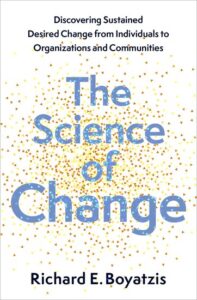
Explore Dr. Boyatzi’s latest book, The Science of Change.
Thriving Starts with You
As you step into the new year, I invite you to pause, before setting new goals or driving toward specific outcomes, and begin with more essential questions:
- What is the personal vision and purpose guiding my life and work?
- What would it mean for me to thrive as a leader and human being—and support the conditions where others can thrive, too?
Because thriving leadership doesn’t start with strategy. It begins with your inner state, the quality of energy, clarity, and purpose you bring into every situation. That means moving toward something meaningful, tending to your wellbeing and growth, and creating space in your life for renewal and purpose. When you do, you become a source of stability, creativity, and courage for the people around you.
Here’s to a 2026 where you don’t just lead—you thrive. When we thrive as leaders, we help shape a future where thriving becomes more possible for all.
About Dr. Richard Boyatzis
Richard E. Boyatzis is Distinguished University Professor of Case Western Reserve University, and a Professor in the Departments of Organizational Behavior, Psychology, and Cognitive Science. He has a BS in Aeronautics and Astronautics from MIT and Ph.D. in Social Psychology from Harvard. His more than 200 scholarly and 50 practitioner articles examine sustained, desired change on leadership, competencies, emotional intelligence, competency development, coaching, neuroscience and management education. He is ranked in the top 2% of all scientists worldwide by PLOS Biology based on his citations; and the top .05% of all worldwide scientists by Scholar GPS, January 25, 2025. His Coursera MOOCs have over 1 ½ million visitors and enrolled from 215 countries. His 10 books include: the international best-seller, Primal Leadership with Daniel Goleman and Annie McKee; Helping People Change with Melvin Smith and Ellen Van Oosten; and the new The Science of Change: Discovering Sustained, Desired Change from Individuals to Organizations and Communities.
Want to receive the latest research, practices and insights on thriving directly to your inbox? Subscribe here.
Wisdom Works’ Be Well Lead Well® newsletter features conversations, strategies, and resources to empower a global movement of change leaders committed to a world where everyone thrives. We are grateful to Dr. Richard Boyatzis of Case Western Reserve University for the generosity of his wisdom in this month’s conversation, and to Dr. Angela Passerelli of Duke University for bringing us together. Wisdom Works’ AI team member, Sage, supported the refinement of this newsletter.
Wisdom Works was founded with the belief that wellbeing and wisdom are the foundation of truly effective leadership. Over 25 years, we’ve supported leaders and organizations worldwide in creating cultures where everyone can thrive. If you’d like to explore how these principles could transform your team or organization, please reach out to us via this form.