Can You Hear Me Now?
As a leader, you are no doubt barraged by the latest management fads, high-tech “solutions” and cutting-edge techniques for achieving results in your company. But did you know that you’re sitting on a mother lode of untapped human wisdom? To mine it, all you need to do is make use of one of your natural-born powers: listening.
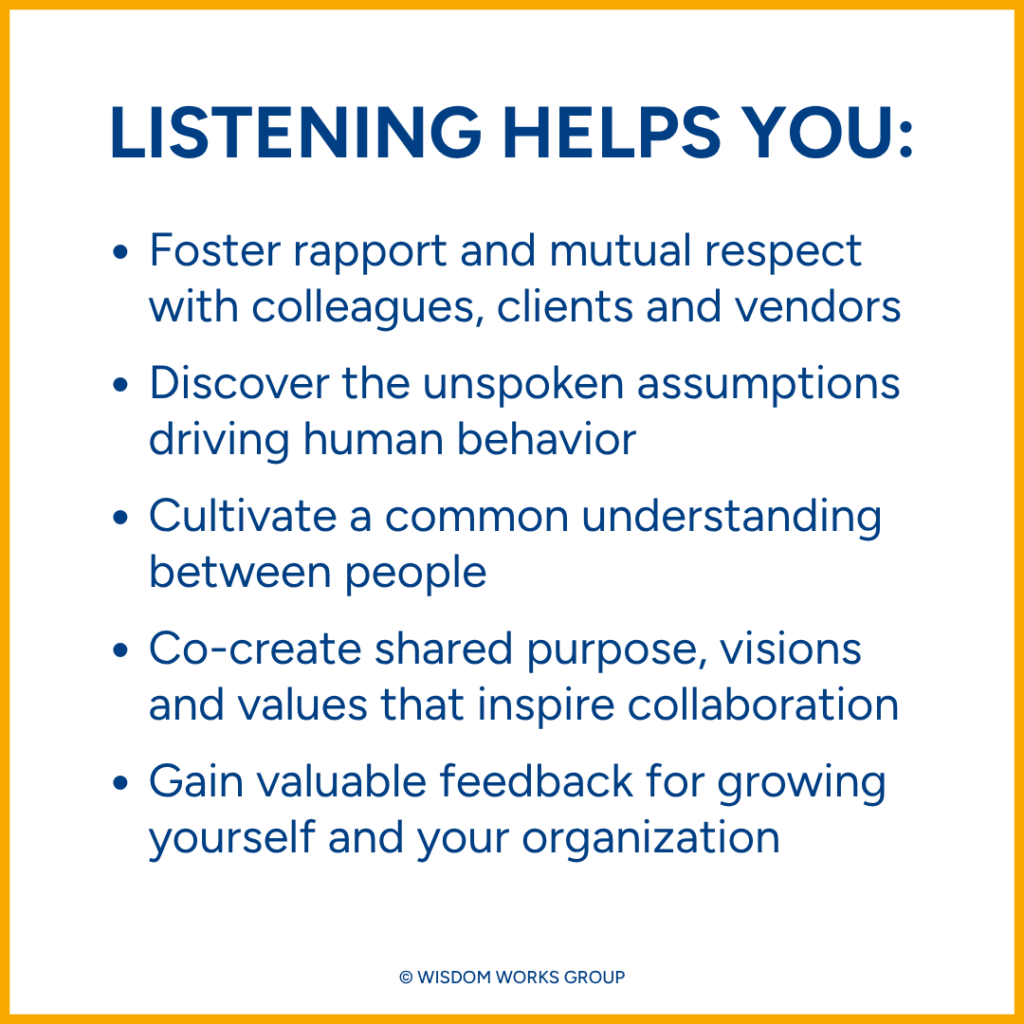
The ability to listen is one of the most priceless tools in the 21st century leader’s tool kit. By genuinely listening—paying attention, actively perceiving and receiving information, hearing what’s said and, better yet, what’s unsaid—you can tap into untold wealth and well-being (or “wellth”) in the organiza-tion. As you cultivate this skill, you learn to identify the latent potentials in people and engage the best in your team, find and nourish previously hidden seeds of creativity and innovation, and sense the deeper pulse of your organization, the market and the world at large. You become better able to create a field for healthier, sustained growth. Undoubtedly, listening is as important a talent as strategic plan-ning, managing crises, making decisions and other leadership prerogatives.
This skill is particularly powerful for building vital, high-performance teams and enterprises. Becoming a deeper listener gives you the leverage needed for taking your leadership to a higher level.
“It is the province of knowledge to speak, and it is the privilege of wisdom to listen.” — Oliver Wendell Holmes
Listening: A Leveling Act
Without genuine listening, we experience poverty in relationships and communications. Yet, if you’re like most people, you probably think that you do listen. And you do. Unless you’ve been trained otherwise, however, the extent and depth of your listening probably leave room for improvement.
The work of Laura Whitworth, combined with Wisdom Works’ experiences in training executives, highlight at least four levels to listening. Each succeeding level asks you to expand your attention and sensitivity to embrace more of what is present, as well as what might become.
- Internal Listening: This kind of listening is autobiographical. While you hear the words of others, you’re primarily interested in what the content means to you personally. (How is what they’re saying going to affect me?) Level 1 has kicked in when your desire for information is strong—you want answers, explanations, rationales, details. Your purpose at this level is to meet your needs.
- Focused Listening: At Level 2, your target is the person speaking. Like a laser, you tune in not only to her words, but also her rhythm, pitch, emotion and body language, all of which help you better under-stand her overall message. (What does she seem to be feeling? What seems to be motivating her?) Already, there is a wealth of information available here that you cannot access through Level 1. At Level 2, you aren’t focused on yourself, your agenda or your thoughts. Nor are you thinking about what to say next. When it’s time to speak, like a mirror, you reflect back to the speaker what you understood so that she feels fully heard and valued.
- Global Listening: This refers to “gestalt,” or whole, listening. At this level, you listen to the speaker, as well as attend to the surrounding environment. (What else is going on in the room?) You also listen for and notice the impact you’re having on others. In Level 3 listening, you bring to play not only your ears, but also your eyes, body, feelings, intuitions and receptive mind. You are open, softly focused and sensitive to the slightest changes in the conversation, which may give subtle hints as to what to do next.
- Generative Listening: Level 4 listening is quite refined—it is listening as a creative act. At this level, you become a finely tuned receiver that picks up not only what is, but what wants to be. (What is being born in this conversation? This relationship?) Through the power of deep listening you discover that something wholly different is elicited: a new idea (perhaps a radical product design), a higher-level understanding of an issue or crisis, strategic questions and solutions that you hadn’t considered before. These emerge without you forcing them to; in fact, they come to bear, in part, because willfulness and ego have temporarily taken a back seat. To operate at Level 4, you fully let go of preconceptions and biases—you sit patiently in the “not knowing,” unthreatened by differences of opinion and worldview, and you allow the act of listening to birth something truly original and worthwhile.
Jane Cocking, Master Certified Coach at Wisdom Works, says that people are hardwired to listen through their personal experience. It’s no surprise then that many leaders get stuck at Level 1. Our ability to simply be curious—to seek another perspective—often becomes blocked by old mental models and routine listening approaches. We automatically assume that we know what others will say when we are faced with a familiar situation, or we believe that what has worked for us will work for them. We’re full of “what we know,” leaving little room for fresh perspective. We forget that every person is dynamic and every situation in a state of flux. There is always more than initially meets the ear.
HOW OFTEN DO YOU LISTEN FROM LEVEL 1?
Want a simple way to find out how frequently your listening swings into Level 1, where you focus on yourself rather than concentrate on the person speaking? Next time you’re in a meeting, put a tick-mark on a sheet of paper every time you notice that your attention has shifted back to your thoughts, feelings or personal agenda. Afterwards, honestly ask yourself: How often did I listen from Level 1? What impact did this have on my participation in the meeting, my interactions with others and the meeting outcomes?
“So when you are listening to somebody, completely, attentively, then you are listening not only to the words, but also to the feeling of what is being conveyed, to the whole of it, not part of it.” — Jiddu Krishnamurti
Amp Up Your Listening
You’re flooded with information 24/7, subject to your unexamined beliefs and conditioned to hear things in a habitual, often selective, way. So, you may be asking, is it even possible to build the listen-ing muscle? Absolutely. Here are three steps you can take.
Step 1: Identify Your Level of Listening.
Distinguish which level of listening is currently in action. (Are you listening from Level 1, 2, 3 or 4 right now?) Consider the impact you would have if you were to listen on a different level.
Step 2: Examine What You Naturally Hear.
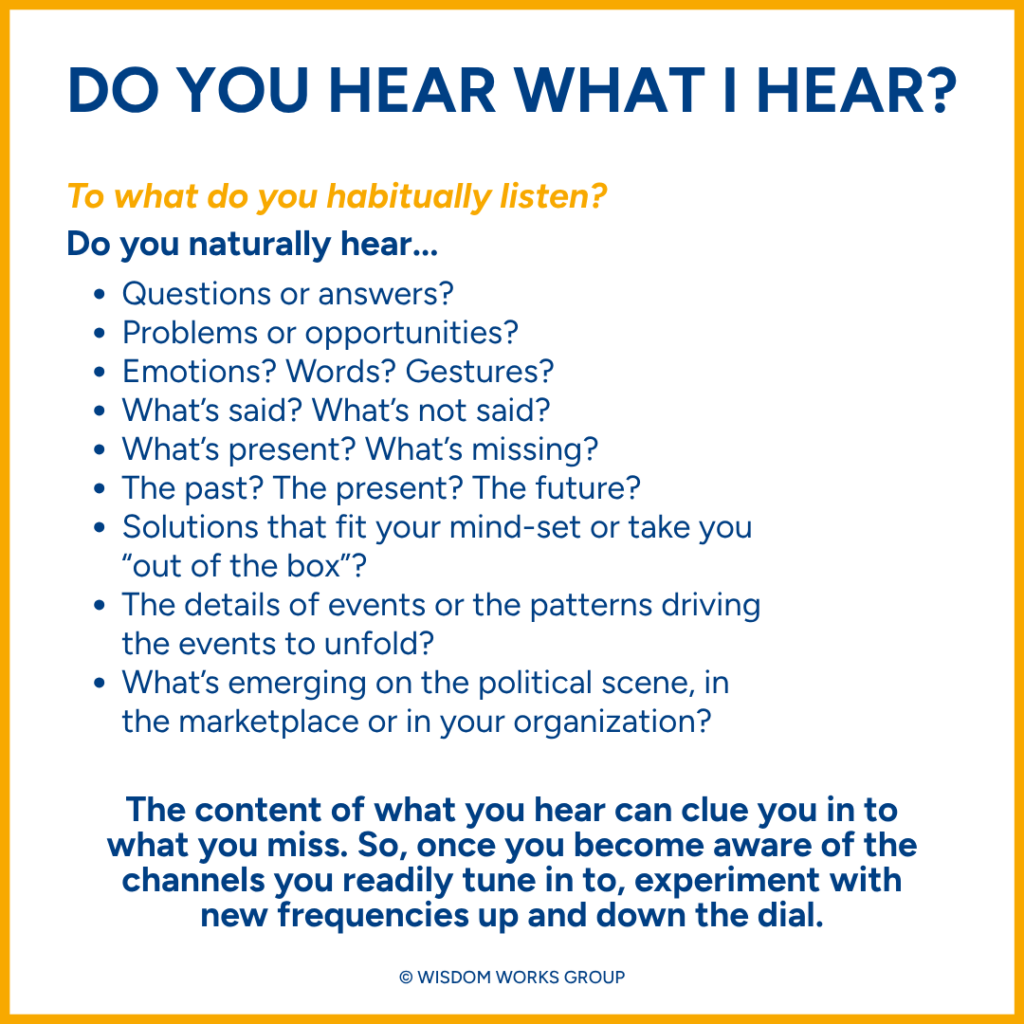
Ask yourself: To what is my listening attuned? (See the sidebar Do You Hear What I Hear?) Plus, take note of any blocks in your ability to listen. Understanding what you listen for and noticing the blocks that get in your way give you a great launch pad from which to expand your listening repertoire.
Step 3: Practice New Listening Skills.
To move to Level 2 listening, experiment with new skills. Skills at this level involve reflecting back to speakers what you saw or heard or understood from them. Here are some examples:
- Bystanding (I notice that you’ve remarked on Bob’s latest decision three times …)
- Paraphrasing (What I hear you say is …)
- Clarifying (I’m still unclear. Can you tell me more about …?)
 At this stage, you’re making it plain to others that you are sincerely striving to hear them. Verify whether you’ve understood what they’re conveying, and use this feedback to refine your Level 2 skills.
To shift your listening to Level 3, heighten your awareness of language, body and emotional cues (I notice that my jaw is tightening as we talk about this issue…), pay close attention to your intuitions (My gut tells me that we’re going in the right direction, even though we don’t have all of the information we want…) and notice the background of the conversation (It seems as though the whole room just settled down during this dialogue.) Now you are using your whole being as an instrument of highly-aware listening.
If you’re up for the challenge of listening at Level 4, practice remaining open to what’s possible, unattached to particular outcomes and patiently trusting of the process. Notice when entirely new questions and ideas emerge, as if your listening is somehow attracting them. Remember: Level 4 listening is akin to being a midwife; the act of full, profound listening can literally bring forth a new quality of thinking and conversation.
Great Leadership Relies on Listening
Great leaders foster greatness in people and organizations. They also usher in new views, value systems, inventions and solutions to improve quality of life overall. They create inviting, fertile environments where healthy relationships are built, incredible work is accomplished and meaningful ways of doing business are produced.
These 21st Century Leaders inherently know what author Brenda Ueland underscores: “Listening is a magnetic and strange thing, a creative force. When we really listen to people there is an alternating current, and this recharges us so that we never get tired of each other. We are constantly being re-created.” Simply by commit-ting to a deeper kind of listening, you, too, can serve as the generative force in your life and your organization, moving beyond leadership as usual to leadership as unlimited possibility.